
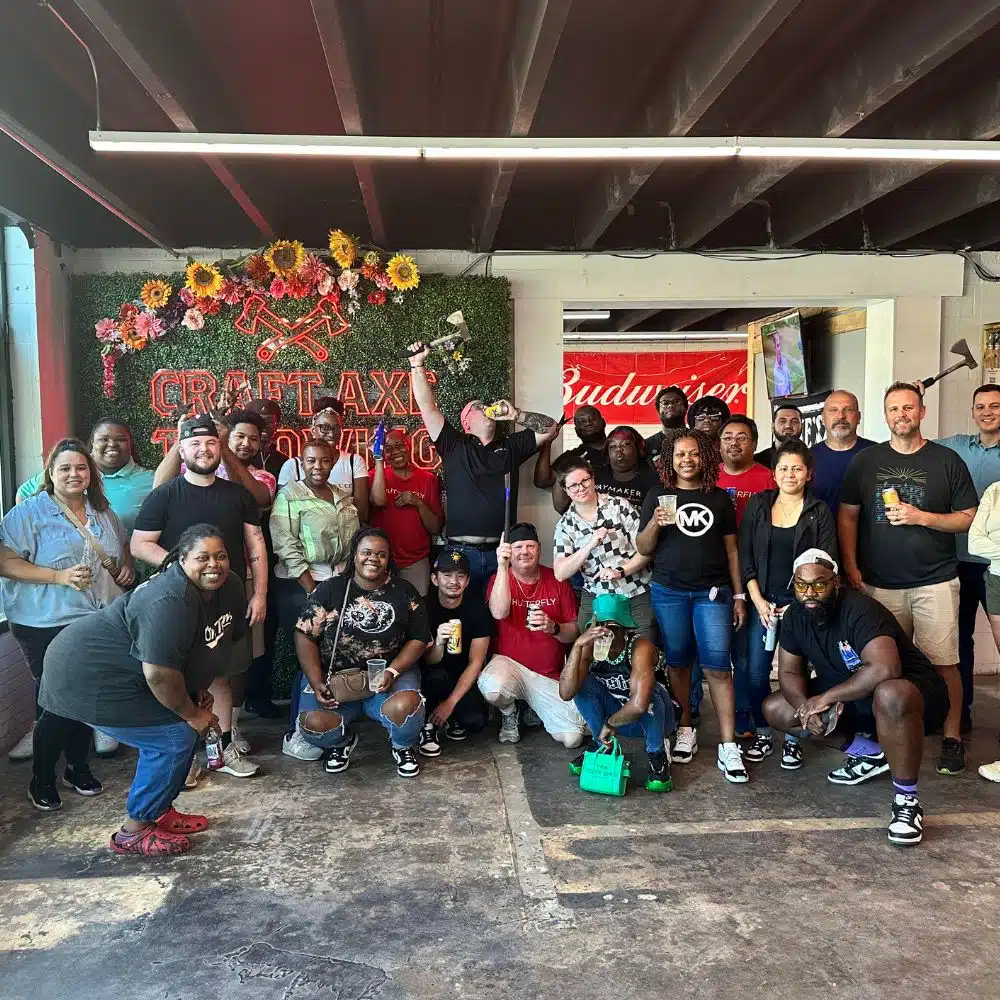
Axe throwing team building is a coached, competitive group event at an axe throwing venue: your team signs waivers, gets a safety briefing, learns to throw from an instructor in about 15 minutes, then competes head-to-head or in a tournament. Events run 1.5 to 3 hours, group pricing starts around 10 throwers, and nobody needs experience or athletic ability.
We’re Craft Axe Throwing - ten physical axe throwing venues across South Carolina, Tennessee, Missouri, North Carolina, and Nebraska - and corporate groups are a huge share of what we host. Tuesdays after work are literally team-building night at our East Ridge venue near Chattanooga, and Wednesdays are corporate-event night in Memphis. This is the guide we wish every event planner had before their first inquiry.
Corporate axe throwing at a glance
- Group size: event pricing starts around 10 throwers; our biggest rooms take event-rate groups of up to 68 throwers, and buyouts go larger.
- Duration: 1.5, 2, or 3 hours. Two hours is the tournament sweet spot.
- Cost: $27–$52 per thrower plus tax at our Columbia, Fort Mill, Lexington, Chattanooga, and Memphis venues; rates vary at our other venues.
- Skill required: none. Coaching is included, and most beginners stick their first axe within 15 minutes.
- Lanes: up to 4 throwers per lane; our venues run 8 to 17 lanes.
- Food: outside food and catering are welcome. Outside drinks are not - venues serve their own craft beer, seltzers, and other beverages.
- Spectators: free. Only the people throwing pay.
How does an axe throwing team building event work?
Every corporate event follows the same basic arc, whether it’s a six-person sales team or a company-wide party:
- Inquire and book. Send your headcount and preferred dates through your venue’s parties and events page (all ten are linked below, or start at the main parties and events page). Groups under 10 can skip the inquiry and simply reserve lanes online.
- Arrive and check in. Everyone signs a waiver - sending the link to your team ahead of time gets a big group throwing faster.
- Safety briefing. A coach walks the whole group through the rules: closed-toe shoes, one thrower on the line at a time, where to stand and when.
- Coached instruction. Coaches teach grip, stance, and release one-on-one until throws start sticking - here’s exactly what they teach. Watching a coworker go from zero to a first stuck axe is reliably the loudest moment of the night.
- Games and competition. Once everyone can stick a throw, coaches run scored games, head-to-head matchups, or a full bracket - and longer sessions unlock ninja stars and premium axes for variety.
- Hang out between turns. Because one person throws at a time, the lane doubles as a hangout: side games, the bar, food, and trash talk fill the gaps naturally.

Why does axe throwing work for team building?
Most team building activities fail one of two ways: someone in the room is already an expert (golf, bowling, trivia), or the activity demands fitness that excludes people. Axe throwing dodges both.
- Everyone learns the same new skill from zero. Almost nobody walks in with axe throwing experience, so the playing field between the sales team and the engineers is genuinely level - and shared beginner status is what actually gets coworkers talking.
- Technique beats strength. Sticking an axe is about rotation and release, not power. Our venues are wheelchair accessible, and coaches can adapt the setup for seated throwers with advance notice.
- The format builds an audience. One thrower on the line means everyone else is watching, cheering, and heckling. The activity generates its own crowd energy instead of splitting people into corners.
- Scoring makes competition instant and objective. A bullseye is worth the same number of points whether the CEO or the newest hire threw it.
One of our Google reviews from a Chattanooga-area team event says it plainly: “Our team had so much fun and Danny brought on the competition! Thank you for making our event so much fun - we will be back!”
How many people do you need for a corporate event?
Group event pricing kicks in around 10 throwers. Below that, your crew can book standard lanes online like any other group - our guide to axe throwing reservations covers how that works.
The lane math is simple: up to 4 throwers share one lane, so a 20-person team throws comfortably on 5 lanes. Our venues run 8 to 17 lanes each, and capacity scales further than most planners expect - Columbia takes event-rate groups up to 68 throwers, and our downtown Memphis venue holds up to 260 people for the biggest company parties. Our axe throwing party planning guide runs the same lane-and-headcount math for birthdays and private groups.
You only pay for throwers. Colleagues who’d rather spectate can watch, keep score, and play the side games free.
How long should a team building session last?
Large-group events run 1.5, 2, or 3 hours:
- 1.5 hours covers the briefing, coaching, and plenty of open throwing - the right length for a weeknight outing.
- 2 hours is the sweet spot for a tournament: enough time for everyone to find their throw and run a bracket without rushing.
- 3 hours fits full office parties where food, socializing, and competition all share the clock.
Need meeting or reception time around the throwing - a quarterly recap, an awards presentation, a catered dinner hour? Our Columbia, Fort Mill, Lexington, Chattanooga, and Memphis venues can add non-throwing event time for $250 per hour alongside an axe throwing event, subject to availability. Other venues quote it individually.
How much does axe throwing team building cost?
At our Columbia, Fort Mill, and Lexington, SC venues and our Chattanooga (East Ridge) and Memphis, TN venues, large-group event pricing is per thrower and drops as the group grows:
| Group size | 1.5 hours | 2 hours | 3 hours |
|---|---|---|---|
| 10–20 throwers | $29/person | $37/person | $52/person |
| 21+ throwers | $27/person | $35/person | $50/person |
Prices don’t include tax. Every duration includes coaching, standard axes, small and large ninja stars, “The Stick All,” and throwing certificates - there’s no upgrade ladder to negotiate at the event tier.
Two other numbers planners ask about:
- Facility rentals (exclusive use of the whole venue) run $800–$1,800 for 1.5 hours at those five venues, depending on the building. Columbia can also rent just its upper floor - three targets, a lounge, a pool table, and a private bar - for smaller private events.
- Our Spartanburg, West Knoxville, Springfield, Graham, and Omaha venues set their own event rates for their local markets - request a quote through each venue’s parties and events page, linked below.
For context on how event rates compare to regular walk-in sessions, see our full axe throwing cost guide.
Can you run a tournament or bracket for your team?
Yes - just ask when you book. Coaches handle tournament setup, and the format flexes to your group: head-to-head brackets for maximum drama, team-vs-team totals to pit departments against each other, or round-robin scoring so nobody’s eliminated after one bad throw. Chalk scoreboards keep the standings public, which is most of the fun. Winners get bragging rights, and event sessions at the five venues listed above include throwing certificates to make it official.
What about food and drinks at a corporate event?
Outside food and catering are welcome at every venue - just bring your own utensils and napkins. Most venues keep a shortlist of local caterers who deliver well; Chattanooga’s list starts with the barbecue joint next door, and Memphis’s includes downtown barbecue and pizza favorites. Ask the events team when you book.
Outside drinks aren’t permitted. Venues serve their own craft beer, seltzers, and other beverages, and offerings vary by location. And because the competition - not the bar - is the center of the event, teams with non-drinkers aren’t stuck watching other people have the fun.
Is axe throwing safe for a work event?
Yes - this is the question HR asks, and the honest answer is that supervised axe throwing is a controlled, coached activity. Every lane is fully enclosed, a coach watches the throwing, only one person throws at a time, and every participant signs a waiver. We’ve hosted hundreds of thousands of throws without an injury. The full breakdown - including what happens if someone throws unsafely - is in our guide to whether axe throwing is safe. The only dress code: closed-toe shoes for everyone who throws.
What does the organizer need to book?
Have these five things ready and the inquiry takes minutes:
- Headcount - throwers vs. total attendees (only throwers are priced).
- A date and a backup date. Two to four weeks of lead time is comfortable; September through December fills fastest, and events outside normal business hours need at least a week’s notice.
- Session length - 1.5, 2, or 3 hours, plus any non-throwing time.
- A food plan - catering in, or a group dinner nearby before or after.
- Anything unusual - seated throwers, a private-space preference, an awards moment that needs a mic.
One policy note worth knowing before you pick a date: events can be rescheduled, but cancellations aren’t refunded - so lock the date your team can actually make.
Where can you book an axe throwing corporate event?
Every Craft Axe Throwing venue hosts team building and corporate events. Start with the location nearest your office:
South Carolina
- Columbia parties and events - 17 lanes on two floors on Gervais St, with a rentable upper floor for private groups.
- Fort Mill parties and events - 10 lanes with room for more than 100 people, minutes from Rock Hill and south Charlotte.
- Lexington parties and events - 8 lanes, the compact option for smaller teams.
- Spartanburg parties and events - 8 lanes plus darts, pool, shuffleboard, and cornhole between turns.
Tennessee
- Chattanooga parties and events - 10 lanes in East Ridge, across the street from Topgolf, so groups often pair the two in one evening.
- Memphis parties and events - 14 lanes downtown across from AutoZone Park, our highest-capacity venue; our Memphis corporate outing guide builds the full downtown itinerary around it.
- West Knoxville parties and events - 12 lanes on N Peters Rd.
Missouri
- Springfield parties and events - 12 lanes in downtown Springfield.
North Carolina
- Graham parties and events - 10 lanes on Main Street in downtown Graham, an easy drive from Burlington and Mebane.
Nebraska
- Omaha parties and events - 15 lanes in downtown Omaha.
Teams spread across offices book us in five states with one planning conversation - and if you’re still comparing options, the parties and events overview covers every event type we host. Send your headcount and a date, and the events team will tell you honestly what works.