
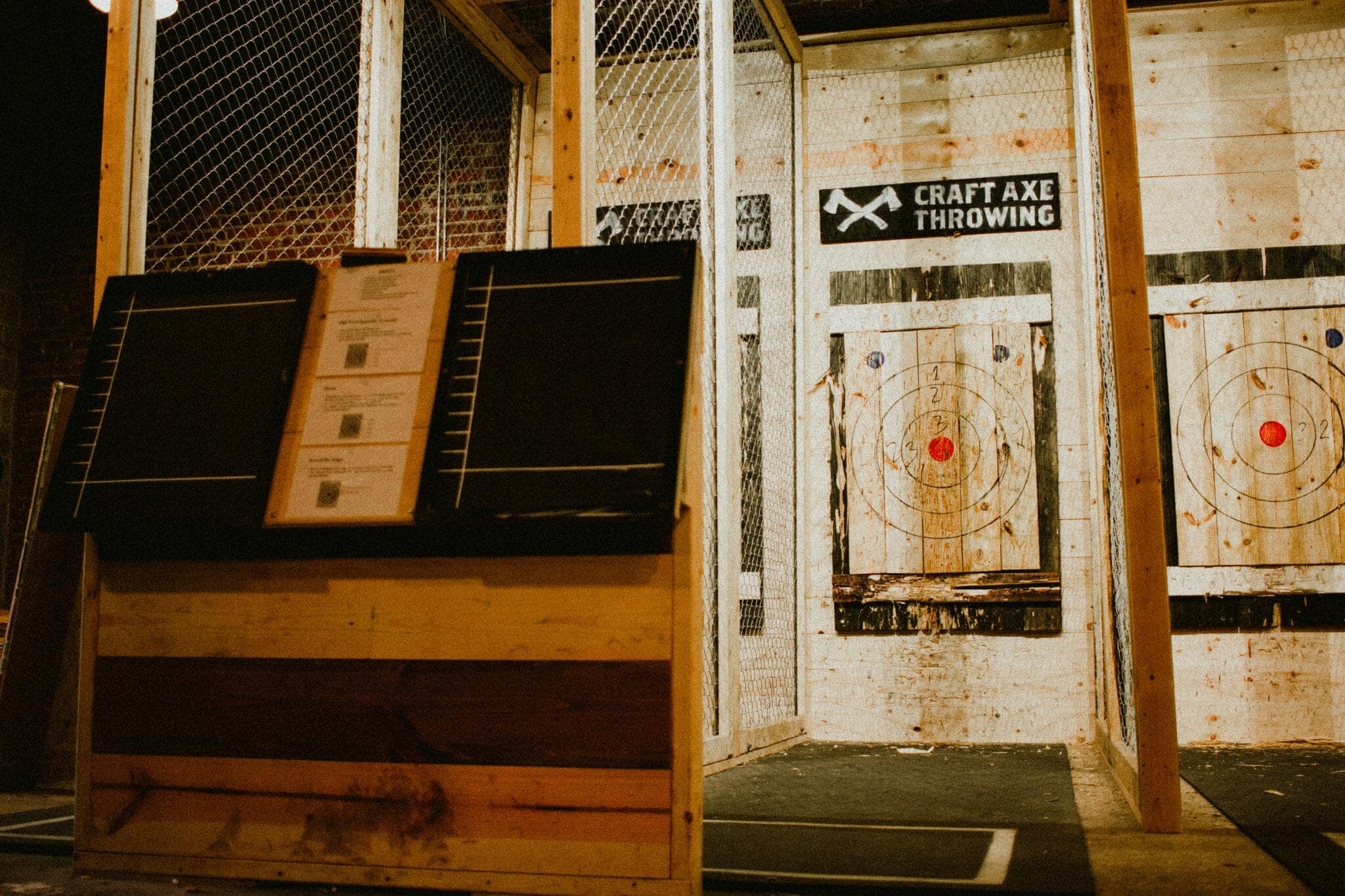
An axe throwing league runs as an eight-week season: seven weeks of weekly competition nights followed by a playoff bracket in week 8. In a WATL-sanctioned league, you throw four 10-throw matches each league night, standings track your wins and total points, and no experience is required - most league throwers started as complete beginners.
The season at a glance:
- Length: 8 weeks - weeks 1–7 are regular matches, week 8 is playoffs
- Weekly format: 4 matches per thrower, 10 throws each = 40 scored throws
- Scoring: standard WATL target - 6-point bullseye, rings from 5 to 1, 8-point called killshot
- Standings: total wins, with total points as the tiebreaker
- Playoffs: a seeded bracket; the championship match is best two-of-three
- Cost: a per-season fee set by each venue, covering all eight weeks
- Skill required: none - leagues welcome first-timers
What is an axe throwing league?
An axe throwing league is organized, recurring competition at an axe throwing venue: the same night every week, head-to-head matches on regulation wooden targets, season-long standings, and a playoff at the end. It’s a physical, in-person target sport - real axes, real lanes, real trash talk - not a video game or an app.
Most competitive leagues in North America, including the leagues at every Craft Axe Throwing venue, are sanctioned by the World Axe Throwing League (WATL), the sport’s largest governing body. Sanctioned means the league follows WATL’s official rules and match format, and your scores are uploaded to WATL the same week you throw them - so a league night at your local venue feeds the same global standings the sport’s top competitors are ranked on.
How is a WATL league season structured?
WATL divides the year into four official eight-week seasons with a break between each one, so a new season starts roughly every three months. Each season breaks down the same way:
- Weeks 1–7: regular season. You throw four matches every week and your wins and points accumulate in the standings.
- Week 8: playoffs. The regular-season standings seed a bracket, and the bracket crowns your venue’s season champion.
A league “week” officially runs Sunday through Saturday, but in practice your venue schedules one league night a week - usually a weekday evening - and the same crew shows up to it all season. That consistency is half the point: weekly reps on the same night are exactly how throwers get good.
What happens on a league night?
A league night follows a rhythm that takes about one visit to learn:
- Check in and warm up. Before matches start there’s open practice - throwers cycle through the lanes, ten throws at a time, dialing in their rotation.
- Throw four matches. Each match is 10 throws head-to-head against a different league member. Four matches means 40 scored throws a night - more concentrated repetition than most casual visitors get in a month.
- Scores get recorded and uploaded. Match results go to WATL the same week, updating your standing locally and globally.
- Hang out between matches. You’re only throwing part of the time. The rest is drinks, scouting your next opponent, and celebrating (or protesting) killshot calls.
We see it at our venues every season - Wednesdays at our East Ridge venue near Chattanooga, for one: league night regulars become a crew. They take the matches seriously, but it’s the same faces every week, and the night is as social as it is competitive. If you’ve been looking for a weekly thing that isn’t trivia or a gym class, this is it.
How does league scoring work?
League matches use the standard WATL target and rules. Every throw scores the ring the blade sticks in: the bullseye is worth 6 points, the rings around it count down 5, 4, 3, 2, 1 - and the blue killshot dots near the corners are worth 8, but only if you call the killshot before you throw, and you only get two calls per match. Miss a called killshot and the throw scores zero.
A match is 10 throws; the higher total wins, and a tie goes to sudden-death killshot throws. We broke down the full target, point values, and killshot rules in our axe throwing rules and scoring guide, and the official WATL rules are the canonical source leagues play by.
How do standings and playoffs work?
Your league standing is built from raw results: total match wins first, with total points scored as the tiebreaker. Win more matches than anyone else through week 7 and you’re the top seed.
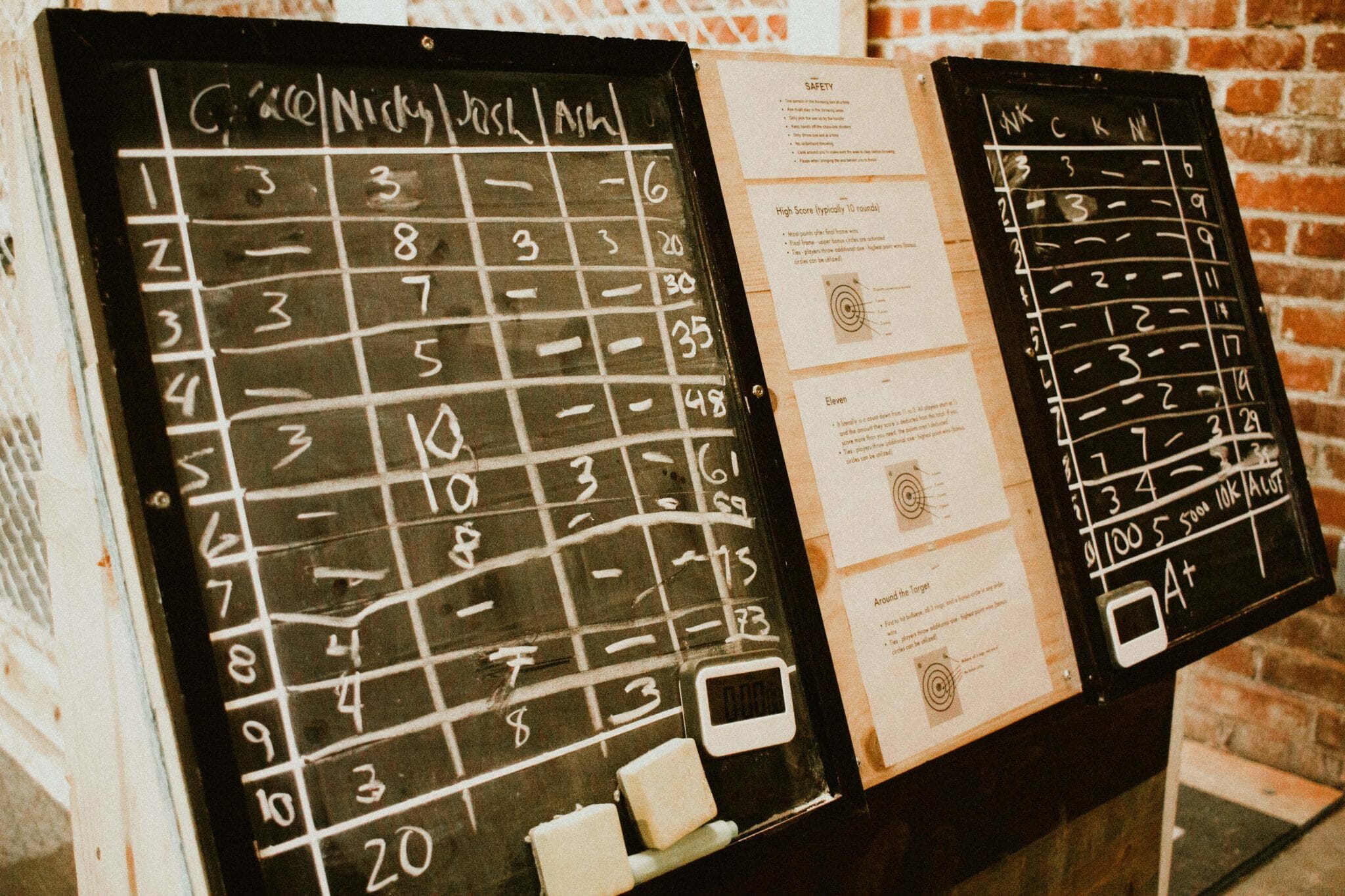
Week 8 is the payoff: a playoff tournament seeded by the regular-season standings. Venues run it as a single- or double-elimination bracket, and the championship match is best two-of-three games. Win your venue’s bracket and there’s a trophy with your name on it - and because the league is sanctioned, strong seasons count for more than bragging rights. Your best league season feeds WATL’s global leaderboard, and top throwers can qualify for regional and national WATL tournaments.
Do axe throwing leagues use handicaps?
No - WATL sanctioned play has no handicap system. Standings are raw wins and raw points, the same for a first-season thrower as for a veteran.
That sounds intimidating and isn’t. Every match is only 10 throws, so upsets happen constantly - one hot killshot swing decides games. And beginners close the gap fast: 40 scored throws a week is a serious practice volume, and the jump from week 1 to week 8 is usually the biggest improvement a thrower ever makes. If you want to accelerate it, our guide to getting better at axe throwing covers the five mistakes coaches fix most, and the practice formats in our axe throwing games guide - 21, Around the World, Cricket - are how regulars sharpen up between league nights.
How much does an axe throwing league cost?
Most venues charge a flat per-season fee that covers all eight weeks of competition; exact pricing is set by each venue. At some of our venues it works out to about $21 a week - less than a typical night out, for a scheduled weekly competition with a playoff at the end. Check the leagues page to find your venue’s schedule and current sign-up details.
Do you need experience or your own axe to join?
No on both counts. Leagues welcome everyone from first-timers to seasoned throwers, your venue provides the axes, and a coach will make sure you have the basics - grip, stance, distance - down before your first match. WATL rules do allow personal axes that meet its specs, and plenty of league regulars eventually buy their own, but nobody starts that way.
You don’t need a team, either. Standard hatchet league is an individual format, and most members sign up solo and get paired into a league night - it’s one of the easiest ways to turn a solo hobby into a standing crew. If you’d rather compete as a pair, WATL also sanctions Duals leagues for two-person teams; ask your venue what formats it’s running.
How do you join a league at Craft Axe Throwing?
Every Craft Axe Throwing location runs WATL-sanctioned leagues on the eight-week format described above. Pick your city on the leagues page to see schedules and sign-up details, or just ask a coach on your next visit - with four seasons a year, the next registration window is never far off. Never thrown before? Start with how to throw an axe, grab a lane at your nearest venue to get a feel for it, and join the next season ready to climb the standings.